

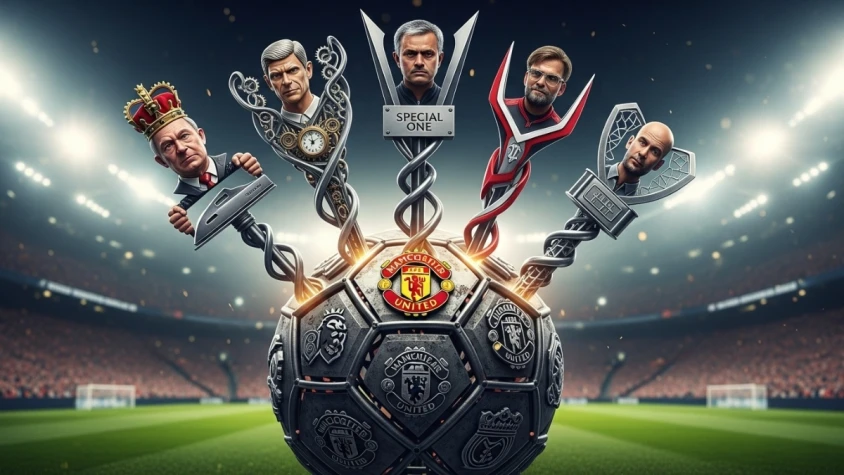
There's a particular kind of silence that settles over Old Trafford, the Emirates, Stamford Bridge, the Etihad and Anfield on certain afternoons. It's the silence of expectation, of history repeating itself, of supporters who have witnessed greatness and now demand nothing less. Since 1992, when the Premier League was born from the ashes of the old First Division, English football has been ruled not by committees or boardrooms, but by dynasties—empires built on vision, ruthlessness, and the occasional stroke of mad genius.
These weren't just successful teams. They were movements. They changed how we thought about football, how we watched it, how we argued about it in pubs and living rooms across the country. And each dynasty, in its own way, killed the one that came before it.
Ferguson's United: the empire that ate English football
When Alex Ferguson arrived at Manchester United in November 1986, he found a club drinking itself to death. The culture was rotten. Norman Whiteside and Paul McGrath, for all their brilliance, embodied an era where afternoon sessions at the pub were considered part of training.
Ferguson dismantled it all. Ruthlessly. Painfully. He once told his players: "I had to lift players' expectations. They should never give in. If you give in once, you'll give in twice." That wasn't motivational poster nonsense—it was a threat.
The transformation took years. By 1990, Ferguson was reportedly one defeat away from the sack. The FA Cup saved him that season, but what saved United in the long run was something far more radical: faith in youth.
The Class of 92 has become the stuff of mythology now, but consider what Ferguson actually did. He watched Alan Hansen pronounce on Match of the Day that "you can't win anything with kids" after a shambolic opening-day defeat to Aston Villa in 1995, then proceeded to prove him spectacularly wrong. David Beckham, Paul Scholes, Ryan Giggs, Nicky Butt, Gary and Phil Neville—these weren't just talented youngsters. They were Ferguson's children, raised on his values, terrified of his temper, devoted to his cause.
Gary Neville later recalled the intensity of those early years at The Cliff training ground: "Being part of that team was a privilege. Eric Harrison's motto was: toughen up. Nobby Stiles was the same."
The peak came in 1999. That Champions League final in Barcelona, trailing Bayern Munich until the 91st minute, should have ended in despair. Instead, Teddy Sheringham and Ole Gunnar Solskjær rewrote history in injury time. Ferguson, never one for understatement, managed only: "I can't believe it. Football, bloody hell."
Thirteen Premier League titles. Two Champions Leagues. An iron grip on English football for the better part of two decades. Ferguson's great insight was understanding that dynasties aren't built on buying stars—they're built on creating believers. As he put it in his autobiography: "The minute a player becomes more powerful than the manager of Manchester United, it's not Manchester United."
Nobody ever became more powerful than Ferguson.
Wenger's Arsenal: when football became art
Arsène Wenger didn't just challenge Ferguson's empire—he questioned its entire philosophy. When the bespectacled Frenchman arrived at Arsenal in September 1996, the British press greeted him with the headline "Arsène Who?" He'd come from Japan. He talked about diet and stretching. He was, quite clearly, an alien.
Within months, he'd transformed Arsenal's old guard. Tony Adams, approaching 30 and by his own admission drinking heavily, suddenly discovered he had another decade of football in him. Patrick Vieira, signed from AC Milan's reserves, became the most complete midfielder in England. Wenger saw what others couldn't see, and he trusted what he saw completely.
The 1997-98 Double was spectacular. The 2001-02 Double was emphatic. But it was 2003-04 that made Wenger immortal.
The Invincibles.
Twenty-six wins. Twelve draws. Zero defeats. An entire Premier League season without losing a single match. When Wenger had suggested such a feat was possible before the 2002-03 campaign, he was ridiculed. Then Arsenal lost six matches that season and finished second behind United. Most managers would have quietly abandoned the idea.
Wenger doubled down. After the 2003-04 triumph, he allowed himself a rare moment of pure joy: "As long as you believe, it is possible. I always had that dream and to fulfil it is marvellous."
What made that Arsenal side so devastating wasn't just Thierry Henry's 30 league goals, though they helped. It was the speed of thought. Dennis Bergkamp dropping deep, finding Robert Pirès cutting inside, Henry sprinting into space that didn't exist until he created it. They played football like jazz musicians riffing off each other, and the Highbury crowd—sophisticated, demanding, occasionally cruel—lapped it up.
The pundit Alan Hansen described them as "quite simply the most fluid, devastating team the British Isles has seen."
But dynasties have expiration dates. The move to the Emirates Stadium in 2006 brought financial constraints. Wenger, ever the idealist, refused to abandon his principles. "We try to go a different way that, for me, is respectable," he said. "I thought: we are building a stadium, so I will get young players in early... the boy comes in at 16 or 17 and when they go out they have a supplement of soul."
Soul doesn't win trophies against oligarchs.
Mourinho's Chelsea: the revolution with a chequebook
José Mourinho didn't sneak into English football. He kicked the door down and demanded everyone look at him.
His first press conference at Chelsea in June 2004 remains the most audacious introduction in Premier League history. Fresh from winning the Champions League with Porto—a club that had no business beating Manchester United and Monaco but did anyway—Mourinho surveyed the assembled journalists and delivered his verdict: "Please do not call me arrogant because what I say is true. I'm European champion, so I'm not one out of the bottle. I think I'm a special one."
The arrogance was calculated. Mourinho understood that Roman Abramovich's billions had given Chelsea resources, but resources alone don't create dynasties. You need an identity. A villain to root for or against. Mourinho made himself that villain.
His Chelsea were brutally effective. The 2004-05 title—their first in 50 years—came with a then-record 95 points and a miserly 15 goals conceded. Claude Makélélé shielded the defence like a bouncer at an exclusive nightclub. John Terry and Ricardo Carvalho allowed nothing through. Didier Drogba terrorised defenders who'd been bossing matches until he arrived.
Sir Alex Ferguson later admitted in his autobiography: "The first time I recognised Jose Mourinho as a potential threat was at his opening press conference. 'What a cheeky young sod', I thought."
That cheekiness was Mourinho's weapon. He called Arsène Wenger a "voyeur" for talking about Chelsea too much. He invented the phrase "parking the bus" to mock defensive opponents. He put his finger to his lips to shush Liverpool fans at Anfield. Every match became a psychodrama with Mourinho at its centre.
Two consecutive titles. Three in total across two spells. But Mourinho's greatest legacy might be this: he proved that the Premier League's cosy duopoly between United and Arsenal could be broken. Money mattered. Ruthlessness mattered more. The game would never be quite the same.
Guardiola's City: the beautiful machine
If Mourinho proved money could buy success, Pep Guardiola proved money could buy transcendence.
When the Catalan arrived at Manchester City in 2016, he inherited a club that had won two Premier League titles but still felt like nouveau riche pretenders. Guardiola didn't just want to win—he wanted to change how English football thought about the game itself.
He succeeded beyond anyone's imagination.
Six titles in seven seasons. Four consecutive championships—a feat unprecedented in English top-flight history. The 2022-23 Treble, matching Ferguson's United in 1999. And always, always, that distinctive style: patient possession, surgical passing, fullbacks inverting into midfield, centre-backs stepping into spaces where centre-backs had no business being.
The numbers are almost obscene. Since Guardiola arrived, City have accumulated 787 league points—46 more than second-place Liverpool over the same period. They've kept 146 clean sheets. They've scored 893 goals.
Gary Caldwell, the Exeter City manager, captured what Guardiola has meant to English football: "More than just winning trophies, he's changed the game and how people view the game across the world. How people view positional play, how you can rotate players in possession, out-of-possession shapes. He's affected how coaches look at the game."
Even League One and League Two teams now try to play out from the back. That's Guardiola's fingerprints on the entire pyramid.
But dynasties built on money face existential questions. The 115 charges against City for alleged financial rule breaches hang over everything. When asked about them, Guardiola was typically defiant: "There is more chance to stay if we are in League One than if we win the Champions League. We are going to defend ourselves."
The man himself, now 54, has hinted he's "closer to leaving than staying." What happens to City without their alchemist remains football's great unanswered question.
Klopp's Liverpool: heavy metal and heavy hearts
Jürgen Klopp never wanted to be compared to Liverpool's legendary managers. At his first press conference in October 2015, he grinned beneath his thick-rimmed glasses and announced: "I'm a normal guy from the Black Forest. My mother is very proud. I am the Normal One, if you want this!"
There was nothing normal about what followed.
Klopp introduced gegenpressing to English football—a system where, as he explained, "you win back the ball nearer to the goal. It's only one pass away from a really good opportunity. No playmaker in the world can be as good as a good gegenpressing situation."
He called it "heavy metal football." Liverpool would press opponents relentlessly, overwhelming them with intensity before they could think. The front three of Mohamed Salah, Sadio Mané and Roberto Firmino became the most feared attack in Europe. Virgil van Dijk and Alisson Becker provided the foundation that Klopp's previous Liverpool teams had lacked.
The 2019 Champions League triumph—a 2-0 victory over Tottenham in Madrid—was emotional. The 2020 Premier League title was cathartic. Thirty years Liverpool had waited. Thirty years of near-misses and broken hearts and watching United and then Chelsea and then City carry off the trophy that should have been theirs.
They finished with 99 points, the second-highest total in English league history. They had been so dominant that the title was mathematically secured with seven matches still to play.
Former Liverpool goalkeeper Bruce Grobbelaar, who won the title in 1990, summed up what Klopp had achieved: "Shankly reincarnated in a German body."
But Klopp, like all great managers, knew when his energy had run out. In January 2024, he announced his departure at season's end, admitting he was "running out of energy" to continue at the highest level. "I am responsible for defeats. The boys are responsible for the wins," he'd always said. That humility, as much as the trophies, defined his dynasty.
What makes a dynasty?
Looking back across three decades of Premier League football, patterns emerge. Every dynasty needed a visionary—Ferguson's iron will, Wenger's artistic soul, Mourinho's psychological warfare, Guardiola's tactical obsession, Klopp's emotional intelligence. Every dynasty needed time—something increasingly rare in modern football's hire-and-fire culture.
Ferguson managed United for 26 years. Wenger stayed at Arsenal for 22. Guardiola is approaching a decade at City. These aren't accidents. Dynasties require patience, require boards willing to weather storms, require supporters who believe even when the evidence suggests they shouldn't.
They also require endings. Ferguson retired at the top, leaving a trophy as his final gift. Wenger stayed too long, watching his beautiful football crumble into frustration. Mourinho's first Chelsea dynasty ended in acrimony with owner Abramovich. Guardiola's era feels like it's entering its final chapter. Klopp walked away on his own terms, which may be the greatest victory of all.
The next dynasty is forming somewhere, right now. Perhaps it's Arsenal under Mikel Arteta, Ferguson's former player, Guardiola's former assistant, trying to synthesise both legacies into something new. Perhaps it's Liverpool under Arne Slot, inheriting Klopp's infrastructure and trying to add his own ideas.
What's certain is that the hunger remains. In press rooms and training grounds and boardrooms across England, men and women are plotting how to build the next empire, how to dominate for a decade, how to make supporters believe that their club—and only their club—has a divine right to win.
That's what Ferguson understood. What Wenger dreamed of. What Mourinho demanded. What Guardiola engineered. What Klopp inspired.
Dynasties don't just win trophies. They make you feel something. And in football, feeling something is everything.


