

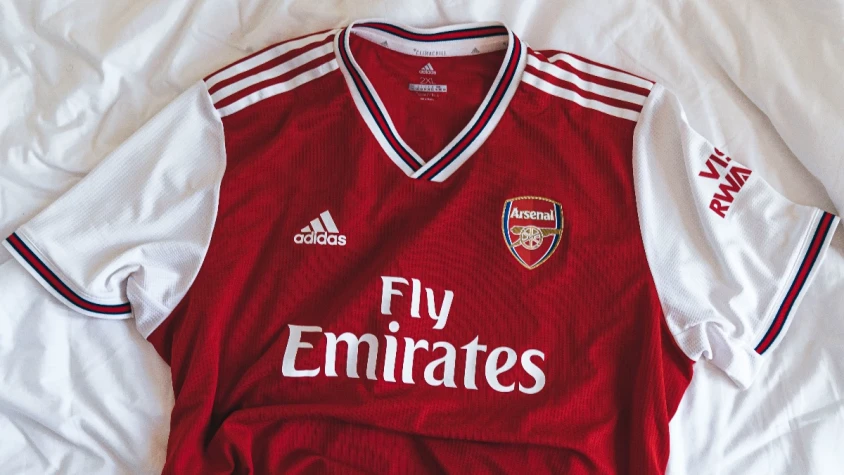
The answer is Ian Wright. And if you grew up watching football in the nineties, you probably already knew that.
Wright scored 185 goals in 288 appearances for Arsenal between September 1991 and the summer of 1998. For nearly a decade, that number made him the most prolific striker in the club's history. Only Thierry Henry has since scored more.
But here's the thing about Ian Wright that makes his story more than just a line in a record book: the man didn't turn professional until he was almost 22 years old. He was working as a plasterer when Crystal Palace finally gave him a chance. Before that, he'd been rejected by Brighton, Millwall, and pretty much everyone else who saw him play.
The long road to Highbury
Wright grew up on the Honor Oak Estate in Brockley, south-east London. His childhood wasn't easy. He's spoken openly about the domestic abuse he witnessed at home, and how football became his escape from a difficult upbringing.
By the time Palace scout Peter Prentice spotted him playing for Greenwich Borough in 1985, Wright had nearly given up on the idea of becoming a professional. According to his own account in The Players' Tribune, he initially turned down the trial offer. Not once, but three times.
The story goes that Wright's friend Tony pushed him to finally accept. "You don't want to get to your old age and think that you could have had an opportunity to be a footballer and you didn't take it," Tony told him. Wright eventually agreed. His supervisor at work helped cover for him by pretending he was sick.
Palace signed him for a fee of weightlifting equipment. Literally. That's what the club paid for a man who would go on to score 117 goals for them and become their post-war record scorer before leaving for Arsenal.
The friendship that shaped everything
One detail that gets overlooked when people talk about Wright's Arsenal career: his childhood best friend David Rocastle was already at the club.
Wright and Rocastle had grown up together on the same estate in Brockley. They attended the same school, Turnham Academy. But while Rocastle was a prodigy who joined Arsenal at 15 and made his first-team debut at 18, Wright was still grinding through rejections.
Rocastle never stopped believing in his friend. Even when Wright was playing Sunday league football while Rocastle was winning league titles at Highbury, he kept encouraging him. The two would meet on Honor Oak bridge when Rocastle was heading to training, and Rocky would tell Wright that the clubs rejecting him were making a mistake.
When Arsenal paid £2.5 million for Wright in September 1991, a club record at the time, the two Brockley boys were finally teammates. Their first league game together came at Southampton on 28 September 1991. Wright scored a hat-trick. Rocastle got the other goal.
Speaking on Desert Island Discs years later, Wright was clear about what mattered most to him: "I don't think of the accolades or the trophies I've won or the England caps—which mean the world to me. All I think about is the fact that I played with him for a year as a professional."
Rocastle was sold to Leeds in 1992, a decision that left both men devastated. He passed away from non-Hodgkin lymphoma in March 2001, aged just 33.
Six seasons of goals
Wright was Arsenal's top scorer for six consecutive seasons. That's worth repeating. Six in a row. Here's how it broke down:
| Season | Goals |
|---|---|
| 1991-92 | 26 |
| 1992-93 | 30 |
| 1993-94 | 35 |
| 1994-95 | 30 |
| 1995-96 | 23 |
| 1996-97 | 30 |
| 1997-98 | 11 |
In his first season at the club, Wright won the Golden Boot with 29 league goals. On the final day, he needed a hat-trick against Southampton to pip Gary Lineker. He got it.
By 1993, Arsenal became the first club to win both the FA Cup and League Cup in the same season. Wright scored in both the FA Cup final and the replay against Sheffield Wednesday.
The day he jumped the gun
Wright entered the 1997-98 season on 174 goals, four short of Cliff Bastin's all-time club record of 178. He scored against Leeds on the opening weekend, then both goals in a 2-0 win over Coventry. Just one more needed.
Then he went three games without scoring. For a striker with Wright's record, that felt like an eternity.
When Bolton came to Highbury on 13 September 1997, Wright was anxious to get it done. Bolton took an early lead, which only added to the tension. Then, in the 20th minute, Wright latched onto a Dennis Bergkamp pass and fired into the bottom corner.
What happened next became one of the most iconic moments in Arsenal's history. Wright ripped off his shirt to reveal a t-shirt underneath reading "179 - Just Done It!"
There was just one problem. That goal was only his 178th. He'd equalled Bastin's record, not broken it.
Wright had to wait another five minutes. Bergkamp broke into the box, his shot was parried, Patrick Vieira knocked the ball across, and Wright tapped in from about two yards. This time, the celebration was justified.
He completed his hat-trick in the second half. Arsenal won 4-1. Wright took home the match ball.
Years later, Arsène Wenger recalled the day: "He chased that record. Like every striker he said, 'I don't care about the goals', but he only thought about that. He was ready to die to score a goal."
A medal at last
That 1997-98 campaign was Wright's last in an Arsenal shirt, and it wasn't entirely happy. Injuries limited his appearances, and a young Nicolas Anelka was emerging as the future of Arsenal's attack. But the season ended with the Double—Premier League title and FA Cup.
Wright was on the bench for the FA Cup final against Newcastle. He didn't get on. But after seven years at the club, he finally had a league winner's medal. He was 34 years old.
Arsenal sold him to West Ham that summer for £500,000. Short spells at Nottingham Forest, Celtic, and Burnley followed before he retired in 2000.
The record falls
Wright's tally of 185 stood until 19 October 2005, when Thierry Henry scored twice against Sparta Prague in the Champions League. Henry eventually reached 228 goals, putting him well clear at the top of Arsenal's all-time list.
But Wright has never seemed bitter about losing the record. If anything, he's celebrated Henry's achievement. The two represent different eras of Arsenal greatness—George Graham's disciplined sides of the early nineties, and Wenger's free-flowing football of the 2000s—but both men are genuine legends of the club.
What remains
Wright finished fourth in a 2008 fan poll of Arsenal's 50 greatest players. He was inducted into the English Football Hall of Fame in 2005 and the Premier League Hall of Fame in 2022.
These days, he's a familiar face on Match of the Day, where he's been a pundit since 1997. He's also become a mentor to younger Black players navigating the pressures of modern football, including Marcus Rashford and Raheem Sterling.
In November 2022, Wright returned to his old primary school in Brockley to open the "Rocky and Wrighty Arena," a small-sided pitch built in his and Rocastle's honour. The project was funded by EA Sports and the Football Foundation.
Wright's two sons, Shaun and Bradley Wright-Phillips, both went on to play professional football. His legacy extends beyond his own career.
So when someone asks who scored 185 goals for Arsenal, the answer is straightforward: Ian Wright. A man who didn't turn professional until 22, who was rejected everywhere before Palace took a chance, who arrived at Highbury to join his childhood friend, and who left as the club's all-time leading scorer.
The record is gone. The story isn't going anywhere.

